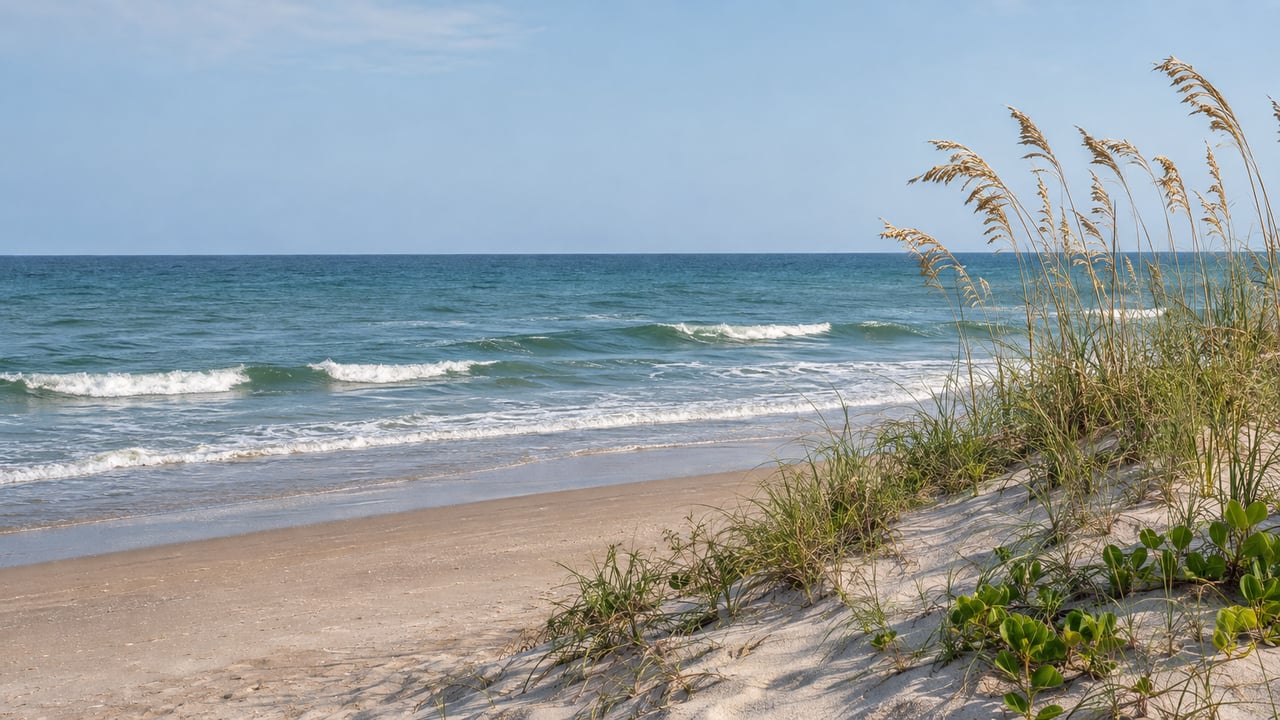
Where to Reach the Beach in Wilbur-by-the-Sea While Heron, Egret and Mallard Are Rebuilt
November 19, 2026
Why has it taken a seven-vote County Council decision, a FEMA grant and a construction contract to get three short walkovers back at the east ends of Heron Street, Egret Avenue and Mallard Street? Volusia County's own project documents say that during Hurricanes Ian and Nicole, "the existing beachfront armoring at the eastern end of Heron Street, Egret Avenue, and Mallard Street in Wilbur by the Sea were severely damaged or destroyed." The walkover you climb is only the top layer. Under it sits the seawall at the end of the street, and the project rebuilds that wall too.
That's why this is a seawall replacement project with walkovers on top, not a quick carpentry repair. It also explains why, in mid-November, the county's Beach Access and Recovery page still lists all three accesses under its closure updates and points beachgoers to Marcelle Avenue to the north and Toronita Beach Park to the south.
The three street ends aren't private walkways or a homeowners association amenity. The project summary says the rights-of-way at the eastern ends of Heron, Egret and Mallard are "controlled by Volusia County," and the county's stated goal is "to repair and improve the armoring and public beach access at these locations."
Because the county controls the land, the county pays for the fix, and the money came from disaster recovery funds rather than the local budget. On April 21, 2026, the Volusia County Council approved a contract with Gregori Construction, Inc. for "the seawall replacement project for Heron Street, Egret Avenue, and Mallard Street," with spending capped at $1,668,500 "from FEMA grant funds." The motion carried 7 to 0. The council's action list for that meeting records the item under the bid number 26-B-38IF.
For a sense of scale, the county put out the bid in January 2026 with an estimated construction cost of $2,112,580.80. The approved contract ceiling came in about $444,000 under that estimate.
The county's scope covers four kinds of work at each street end. The project requires:
Only one of those four items is the walkover itself. Most of the scope is the wall and the ground around it.
The bid set a clock for that work. The draft contract calls for substantial completion within 120 days and final completion within 150 days, both counted from the county's notice to proceed.
Anyone who has walked to the end of Heron, Egret or Mallard knows how narrow these street ends are. The county says so in writing. Its project summary notes that "all three project locations have minimal space for materials and equipment and are bordered by private properties and a heavily traveled road."
That sentence describes the conditions the crews work in. Each street end gets a full seawall build with private property on both sides, the beach in front and S. Atlantic Avenue behind. All three accesses are closed while crews build the new access structures and seawalls.
Sand placement along this stretch came before the seawall work. The county's FY 2025-26 capital project schedule lists the "Berm Restoration North of Ponce Inlet" project, serving Daytona Beach Shores, Wilbur-by-the-Sea and Ponce Inlet, as complete. That work placed about 400,000 cubic yards of sand at a total project cost of $8,711,592. The county's sand placement project page reported in its February 25, 2026 update that the berm was finished and that more than four miles of shoreline had received sand.
So the sand in front of the street ends has been rebuilt, and the public walkways up to it are now getting their turn. The capital schedule lists the berm work line by line for anyone who wants the full record.
The county names two alternatives, one in each direction.
| Alternative | Direction from the closed accesses | What the county lists there |
|---|---|---|
| Marcelle Avenue | North | Named by the county as the northern alternative access |
| Toronita Avenue Beach Park, 4200 S. Atlantic Ave. | South | Restrooms, showers, a signalized crosswalk, a beach ramp, and a design that is accessible to people with disabilities |
Toronita is the one with facilities. The county describes it as a "picturesque, handicapped accessible park" with restrooms, showers and "a signalized crosswalk to the beach via the Toronita Avenue beach ramp." It sits about 2 miles south of Dunlawton Boulevard.
A few details on the Toronita Avenue Beach Park page are useful before you head out:
The signalized crosswalk matters on this stretch of A1A. If you live near Heron, Egret or Mallard, you would normally have crossed at your own street end. Walking or biking south to Toronita gives you a signal to cross at.
Driving to Toronita means using a county-owned lot, and the county page says that since January 1, 2025, all county-owned and operated off-beach parking lots charge a $20 daily fee, separate from on-beach driving fees. Volusia County residents can park free if they register their vehicles online at ParkVolusia or in person at a ParkVolusia office, including the one at 302 North Causeway in New Smyrna Beach.
If you've already registered a car for county beach parking, that registration is the one that applies at Toronita. Our recent post on how New Smyrna Beach is moving to license-plate beach access on Jan. 1 explains why keeping that vehicle record current matters across the county. Check the ParkVolusia site before you go, since it shows the current rules for each vehicle.
The county's Beach Access and Recovery page lists closures under a "Closure Updates" heading. It also links to lists of open pedestrian accesses and open accessible pedestrian accesses, plus a section on progress on beach access and walkover projects. When Heron, Egret and Mallard drop off the closure list and appear among the open accesses, the new walls and walkovers are back in public use.
The same page shows other closures along this part of the coast. The El Portal vehicular ramp is closed while crews build a new ramp, with the Dunlawton Beach Ramp as the alternative to the south and the Van Ave Beach Ramp to the north. If you usually drive onto the sand rather than walk over a dune, that's the listing to watch.
When the three street ends reopen, the walkovers will look new, but most of what the county paid for will be the seawalls underneath them. Those walls are what will hold the ends of Heron Street, Egret Avenue and Mallard Street the next time a storm reaches this shoreline.
For more on this stretch of coast between Daytona Beach Shores and Ponce Inlet, see our Wilbur-by-the-Sea neighborhood page and our post on the Lighthouse Point Park rebuild in Ponce Inlet.
We follow projects like this because the walk from your front door to the sand is part of what a home in Wilbur-by-the-Sea is worth. If you'd like to talk about how the street-end rebuild fits into your plans for a home near Heron, Egret or Mallard, the team at Greg Sessions would be glad to hear from you. Contact Us.
Discover a higher standard of service with Gabi & Greg, offering expert market insights, personalized guidance, and a commitment to exceeding your expectations every step of the way.

Gabriele “Gabi” Sessions, REALTOR®, GRI
Greg Sessions, REALTOR®
REALTY PROS ASSURED (PORT ORANGE OFFICE) 301 Dunlawton Ave Port Orange, FL 32127 GABRIELE SESSIONS | LIC #3409639 GREGORY SESSIONS | LIC #3652374 REALTY PROS ASSURED LLC | LIC #CQ1032779